Current work

Agentic workflows for semiconductor engineering

Experts make the judgment calls. Agents handle the repeatable work around them.

  1. 01

    Bounded autonomy for compact modeling

    A general-purpose LLM agent can perform selected compact-modeling tasks when its tools and actions are bounded by physical checks, with every step left available for engineering review.
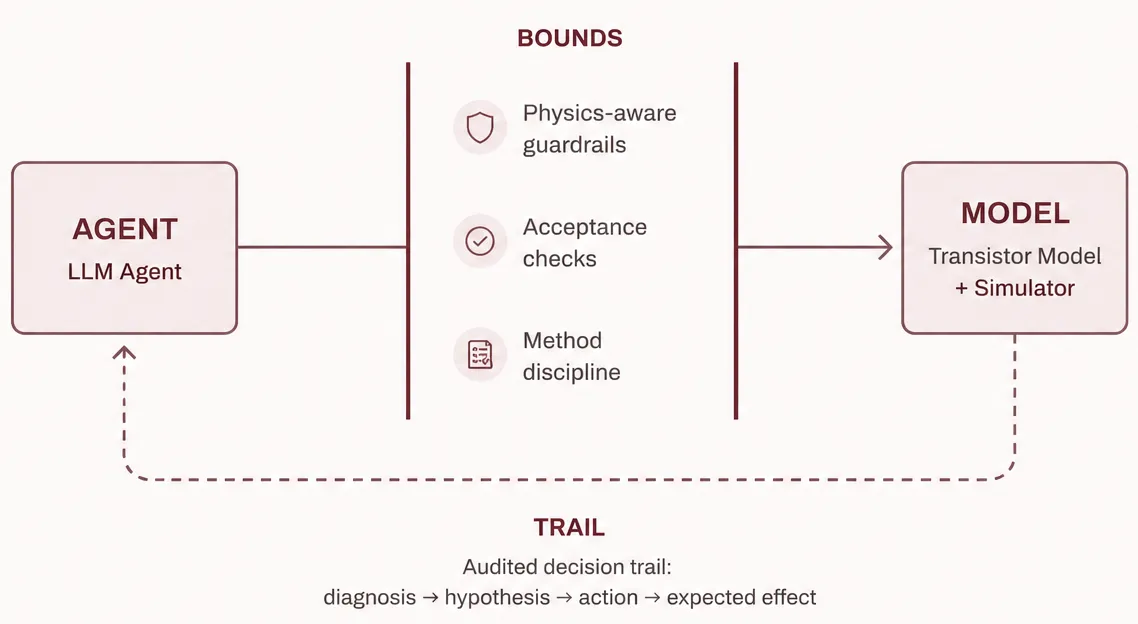
    A typed tool layer sits over an open-source circuit simulator and a standard industry transistor model. Engineering checks enforce parameter scope and physical bounds before and after every change. The agent records its diagnosis, hypothesis, and expected effect before it acts. A senior engineer’s worked demonstration supplies the operating method.

    Evaluation was a controlled study rather than a demonstration. It used real calibration tasks with known ground truth, held-out task variants, measured SKY130 silicon data associated with an open process design kit, and open model cards.

    The contrast showed what the harness contributes. Without explicit scope, physical checks, and a usable method, an agent could produce convincing curves through unsupported parameter changes or by fitting effects the data could not identify. With the complete harness in place, it stayed within scope, focused on the engineering objective, and left unsupported parameters untouched. The controls improved both the result and the reasoning process behind it.
    • Compact modeling
    • Agent harness design
    • Controlled evaluation
  2. 02

    From execution to a learning loop

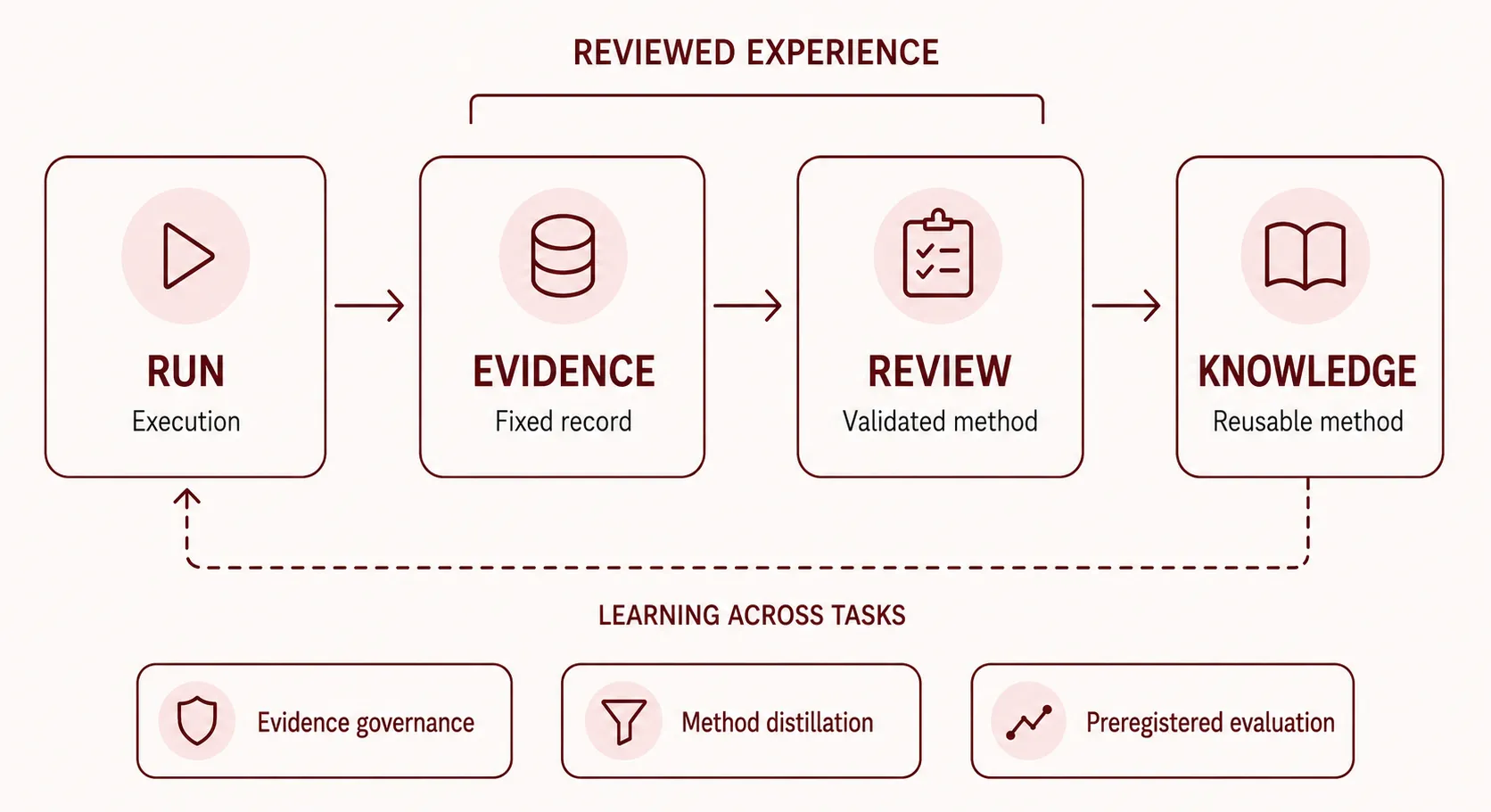
    Reviewed work can carry experience from one task to the next without changing model weights. Current studies test whether governed records change later decisions, rather than merely the language used to explain them.

    The system is designed to carry reviewed methods from one task into the next. Each agent run is stored as an immutable, schema-checked record that later runs cannot overwrite. A method becomes reusable only after review has recorded where it applies, a test that can be rerun, and the counterexamples already known.

    The agent records its stated rationale before each action, so the history holds more than a sequence of parameter edits. It also records why each change was made, which is what makes the history worth distilling.

    The learning loop has already shown a concrete effect. In controlled paired evaluations, a reviewed method changed both the agent’s mechanism diagnosis and the procedure it performed, rather than merely changing its explanation. This is the purpose of the loop: preserve experience as evidence, distill it into a usable method, and test that method before it guides later work. A blinded out-of-sample study is now testing how well the effect carries to new tasks.

    • Evidence governance
    • Method distillation
    • Preregistered evaluation
  3. 03

    The domain, compiled for agents

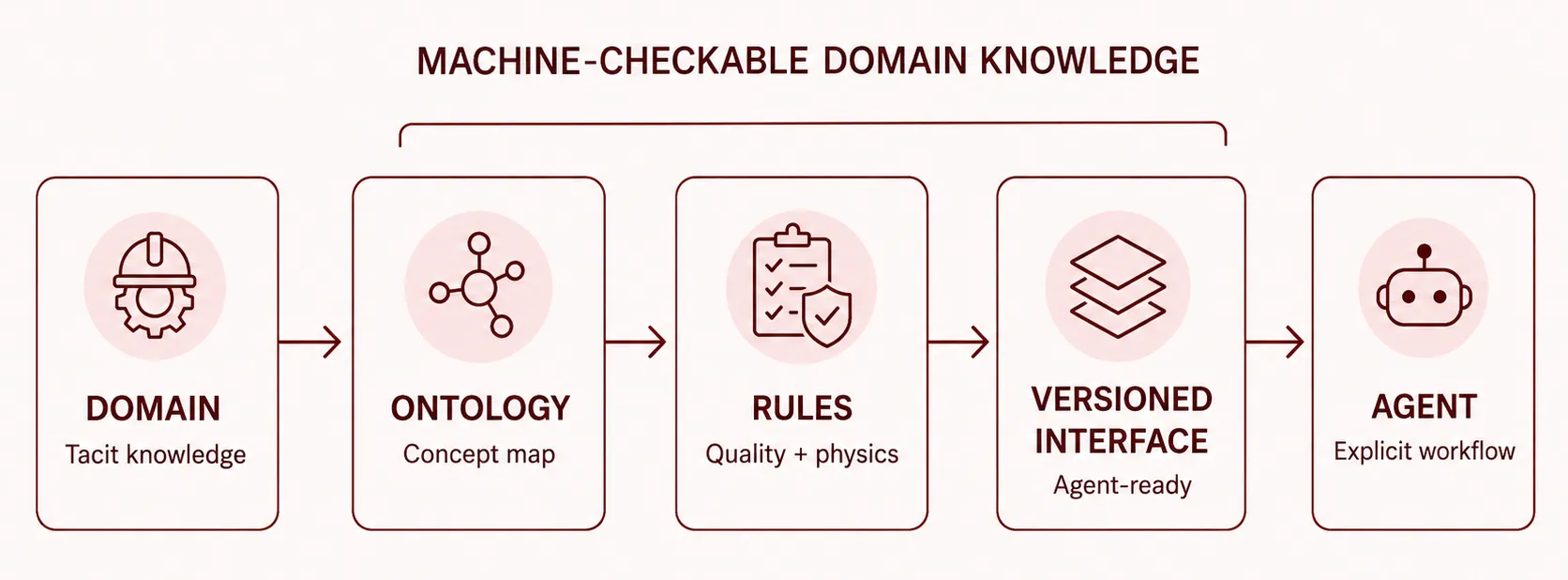
    An agent can follow only a workflow that has been made explicit. Extending this approach beyond compact modeling requires a versioned, machine-checkable representation of domain concepts, quality rules, figures of merit, and physical constraints.

    Much of compact modeling is tacit. Engineers still have to judge what a parameter means, which measurements support a claim, and what counts as an acceptable fit. The ontology represents those judgments as a structured map of domain concepts, relations, quality rules, and figures of merit. Its own rules are checked automatically, each concept keeps a stable identity, and every version is preserved.

    A process design kit is a useful analogy. A PDK does not expose the full manufacturing process. It compiles selected process knowledge, constraints, models, and verification interfaces into a form design teams can use. This work builds a comparable interface around the engineering work itself.

    This layer may extend beyond compact modeling, but that claim still needs evidence. Semiconductor engineering is a useful test case: much of its expertise remains tacit, and its mistakes are expensive.

    • Compact-modeling ontology
    • Machine-checkable rules
    • Versioned domain knowledge

How I got here

Trajectory

I ran these engineering workflows before I began building systems to automate their repeatable parts. Each stage below shaped what I build now.

  1. 2019 to 2023

    Graduate Research Assistant, Purdue University

    Birck Nanotechnology Center · Prof. Peide D. Ye

    Atomic-layer-deposited oxide-semiconductor transistors for BEOL-compatible and monolithic 3-D integration.

    More than 5,000 hours in Purdue cleanrooms taught me to treat process control, measurement, and evidence as one continuous engineering loop.

  2. 2024 to 2025

    Senior Device Engineer, HiSilicon

    Advanced-logic vertical gate-all-around device development, from structure design through tape-out in a 300-mm wafer fab.

    Learned where expert hours go: test-data triage, experiment tracking, and model recalibration as new silicon arrived.

  3. Apr 2026 to Present

    Postdoctoral Researcher, The Chinese University of Hong Kong

    Department of Computer Science and Engineering · Prof. Bei Yu

    AI agents for semiconductor compact modeling and design-technology co-optimization, with the evidence infrastructure needed to verify their output.

    Now building the tools, guardrails, and evidence layer that let an agent do that modeling work with its decisions and actions on the record.

  • Ph.D., Microelectronics Electrical and Computer Engineering Purdue University Birck Nanotechnology Center 2023
  • B.S., Applied Physics School of the Gifted Young University of Science and Technology of China 2018